How AI Is Transforming Team Management in 2026
AI team management tools are changing how leaders measure performance, act on feedback, and support their people. Here's what's actually working in 2026 — and what isn't.
AI team management has moved well beyond the hype of 2023 and 2024. In 2026, the teams making the biggest gains are not those that adopted the most AI tools — they are those that adopted the right ones and built them into their management rhythm consistently.
This guide covers how AI is actually being used to transform team management today — from feedback analysis and action planning to meeting facilitation — and where the technology still falls short.
Key takeaways
- AI's biggest impact on team management is speed: compressing the gap between collecting feedback and acting on it from weeks to minutes.
- The highest-ROI AI tools are team health platforms that analyze survey data and generate specific actions — not general-purpose writing or scheduling assistants.
- AI cannot replace the relational work of management: building trust, reading a room, and following through over time remain entirely human.
Table of contents
How is AI changing the way managers lead their teams?
AI is changing team management by compressing the time between collecting feedback and acting on it from weeks to minutes. The most impactful applications in 2026 are AI-powered survey analysis, automated action plan generation, and real-time meeting facilitation support — all targeting the gap between what managers know and what they do.
The traditional management feedback cycle had an obvious bottleneck: data collection (a survey) was disconnected from analysis (a consultant or HR team reviewing results) which was disconnected from action (a plan that took weeks to produce). By the time anything changed, the original problem had often evolved into something worse.
McKinsey's research on AI-driven HR found that organizations using AI to shorten the feedback-to-action cycle reported 30–40% faster resolution of team issues compared to those relying on traditional quarterly review processes.
AI is specifically making a difference in four management areas:
- Feedback analysis — AI processes survey results at scale, identifying patterns, outliers, and correlations that would take human analysts hours to spot.
- Action plan generation — based on survey data, AI surfaces specific, prioritized actions drawn from evidence-based organizational psychology frameworks — grounded in research, tailored to the team's dimension scores, not generic best-practice lists.
- Meeting preparation — AI generates structured discussion guides and conversation scripts so managers can have difficult conversations with appropriate framing.
- Trend detection — AI tracks metrics over time and alerts managers when a dimension of team health is trending in the wrong direction before it becomes visible in performance data.
What AI tools are most useful for team managers in 2026?
The most useful AI tools for team managers in 2026 fall into three categories: team health platforms that analyze survey data and generate actions, AI writing assistants that help managers prepare for difficult conversations, and scheduling and prioritization tools that reduce cognitive overhead. The highest ROI comes from the first category.
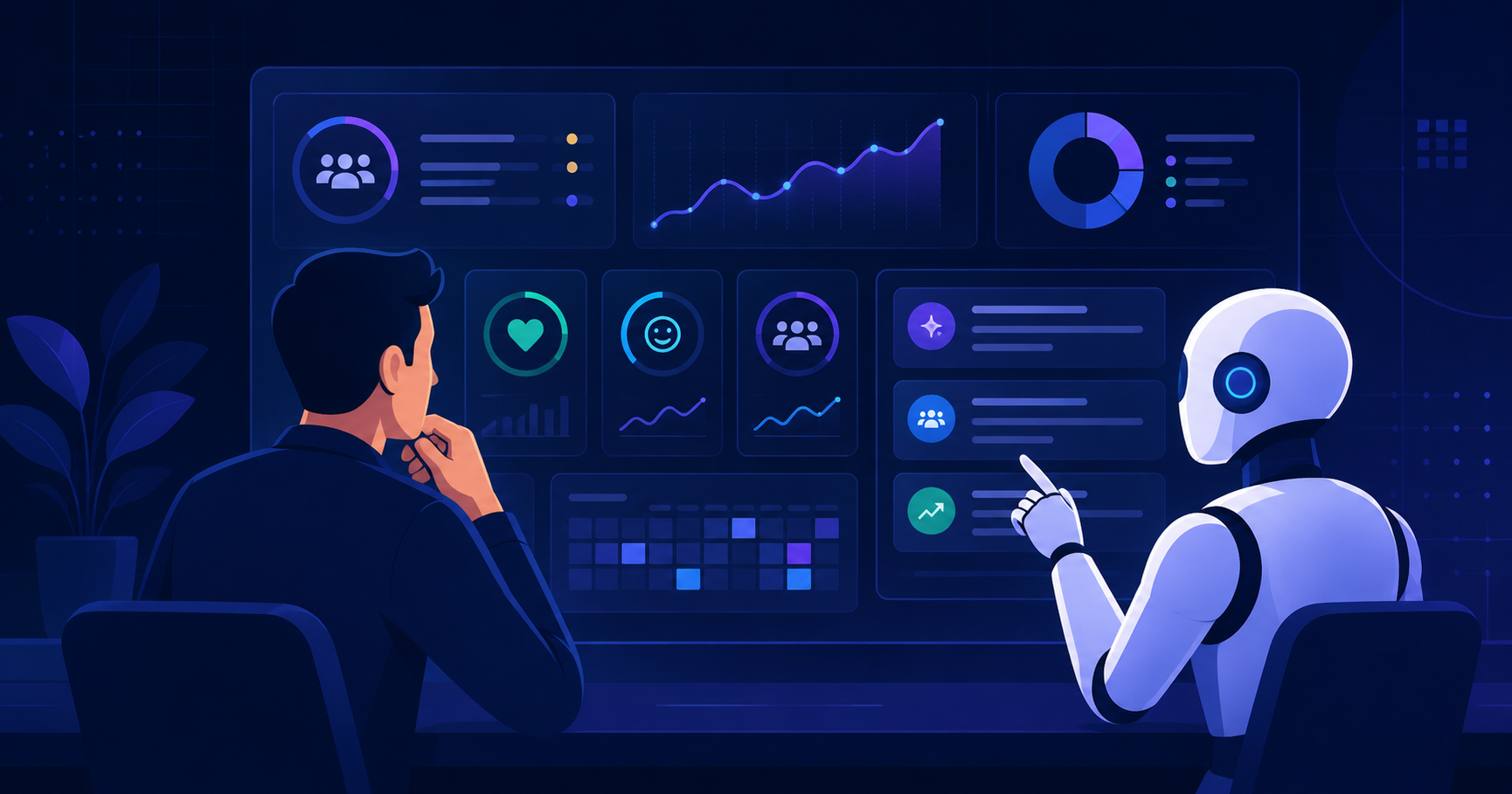 AI tools for team managers in 2026 — survey analysis platforms deliver the highest ROI for team health outcomes.
| Tool category | What it does | Where the ROI comes from |
|---|---|---|
| Team health & survey analysis platforms | Collects anonymous feedback, analyzes it against research-backed frameworks, generates specific action items | Direct — pattern recognition across dimensions identifies which intervention is most likely to move the needle |
| AI meeting & conversation preparation tools | Helps managers prepare structured agendas, generate talking points for 1:1s, or draft scripts for difficult conversations | Direct — reduces the friction that stops managers from having conversations their teams need |
| Scheduling, prioritization & productivity AI | Reduces administrative burden — scheduling, email triage, project status summarization | Indirect — frees time from admin overhead, giving managers more capacity for the human work of leading |
How does AI help managers turn survey feedback into action?
AI turns survey feedback into action by identifying the highest-priority problem area from the results, generating 3–5 concrete interventions ordered by likely impact, and providing ready-to-use communication materials (meeting scripts, team announcements) so the manager can act immediately rather than spending days interpreting data and drafting responses.
The traditional alternative — sending survey results to a consultant or HR team for analysis, waiting for a report, then translating recommendations into team-specific actions — takes 2–6 weeks. Most of that time is organizational overhead, not analytical complexity.
AI compresses this to minutes. A well-designed AI system can:
-
Score responses by dimension
Aggregate individual answers into psychological safety, clarity, connection, and purpose scores with statistical confidence levels.
-
Identify root cause candidates
Cross-reference low-scoring questions within a dimension to surface the most likely underlying issue.
-
Generate prioritized actions
Produce a ranked list of specific interventions, with the highest-impact actions first rather than a generic best-practice checklist.
-
Draft communication materials
Create a meeting script, talking points for a team debrief, or a 1:1 conversation guide that the manager can use or adapt immediately.
This is exactly what Arenevo does — automatically, after every survey. When responses arrive, it scores all four research-validated dimensions and surfaces 3–5 evidence-based action recommendations derived from established organizational psychology frameworks (Edmondson, Locke & Latham, Baumeister & Leary, Deci & Ryan), plus ready-to-use meeting scripts for the most sensitive issues. The gap between "survey closed" and "manager has a plan" is measured in minutes, not weeks.
What are the limits of AI in team management?
AI cannot replace the relational work of management. It can identify that psychological safety is low, generate a conversation script, and suggest that a manager hold a specific 1:1 — but it cannot have that conversation, build trust through presence, or respond to the human nuance in a team member's face. AI amplifies management capacity; it does not substitute for it.
The clearest limits of current AI in team management:
- Context blindness — AI works with what it is given. It does not know that your team just lost a key client, that two members have a history of conflict, or that the company is rumoured to be cutting headcount. Human context is irreplaceable.
- Relationship quality — trust between a manager and their team is built through consistent, reliable human behaviour over time. No AI can substitute for a manager who follows through, listens well, and shows up for their people.
- Cultural nuance — AI action plans may not account for team-specific culture, seniority dynamics, or communication norms that shape how interventions land.
- Implementation — the AI can generate the plan. Executing it, adapting to resistance, and sustaining change over months is entirely human work.
The most effective approach treats AI as a force multiplier for the management work that already works — not as a replacement for it. Harvard Business Review's analysis of AI in management concludes that the leaders who benefit most from AI tools are those who use them to do more human work — more 1:1s, more feedback conversations, more time with their teams — not less.
Putting it into practice
- Audit which of the three tool categories above your team already uses, and check whether the budget is actually going toward the survey-analysis category — the one with the highest direct ROI.
- Before your next survey cycle, confirm your action-plan turnaround time. If it's still measured in weeks rather than minutes, that's the first gap to close.
- Pick one AI-generated recommendation this quarter and track whether it was actually implemented — not just generated — 30 days later.
Frequently asked questions
These are the most common questions about AI in team management.
Will AI replace HR managers or team leaders?
No, AI will not replace HR managers or team leaders in any near-term timeframe. AI excels at pattern recognition, data analysis, and generating structured content. It cannot build trust, navigate interpersonal conflict, or make judgment calls that depend on organizational context, relationships, and lived experience. The most likely outcome is that AI-augmented managers become significantly more effective — raising the bar for what good management looks like rather than eliminating the role.
Is AI-generated feedback safe to use with your team?
AI-generated action plans and meeting scripts are safe to use as starting points — not finished products. Always review AI output for context accuracy before using it with your team. AI does not know your team's specific history, sensitivities, or current dynamics. Treat AI suggestions as a first draft that you adapt rather than a recommendation you follow verbatim.
How do employees feel about AI tools being used to manage them?
Acceptance depends heavily on transparency and use case. Employees are generally comfortable with AI tools that help managers act on their feedback faster — they see this as AI working for them, not on them. They are more skeptical of AI tools that monitor productivity, score performance, or make recommendations about promotions or compensation. Lead with the former; proceed carefully with the latter.
What should you look for in an AI team management tool?
Look for tools built on validated research models, not improvised question sets. You also want genuine anonymity guarantees (not just claimed anonymity), action-oriented output (specific recommendations, not dashboard-only reporting), and a track record of engagement — high response rates require that employees trust the platform. Prioritize tools where the AI's job is to make the manager more effective at the human work, not to automate the human work away.
How much does AI team management software cost?
Pricing varies significantly by use case and scale. Entry-level tools for individual team leaders start from €9–€29/month. Mid-market platforms for HR teams managing multiple departments typically run €2–€10 per employee per month. Enterprise solutions with advanced analytics and integrations can reach €15–€30 per employee per month. The ROI case is typically made through reduction in turnover and faster resolution of team issues — a single retained high-performer usually covers months of platform cost.
Simone has spent over a decade building and advising software teams across Europe. He co-founded Arenevo to give team leaders an honest, data-driven way to measure and improve team health.
Ready to improve your team health?
Arenevo turns anonymous survey feedback into concrete actions in minutes — no spreadsheets, no guesswork.
Start your free trial →Related Articles
How AI Coaching Alerts Flag Burnout Before Reviews
AI coaching alerts flag early burnout signals from ongoing survey data, often weeks before a formal...
12 min read
Leadership Blind Spots: Why Managers Rate Teams Higher
Leadership blind spots explain why managers consistently rate team health higher than their teams do...
12 min read
Manager Self-Assessment vs Team Feedback: Closing the Gap
A manager self-assessment, compared side by side with anonymous team feedback, is the most reliable...
13 min read